
Header Background

Latest News

Are downsizer contributions losing steam?

Are downsizer contributions losing steam?

Tax Office data shows fewer people used its super scheme in 2024-25

.

Introduced in 2018, the home downsizer scheme allows eligible Australians aged 55 and older to contribute up to $300,000 from the sale of their home into superannuation, outside of normal annual contribution caps.

The idea was simple: improve retirement incomes while freeing up larger homes for younger families.

For eligible couples, up to $600,000 can be taken from their total home proceeds and split equally between their respective super accounts.

Yet, since peaking in 2021–22 when almost 20,000 people made downsizer contributions totalling just over $5 billion, both the number of contributors and the total value of contributions has declined. Last year 15,800 Australians took advantage of the scheme and contributed a total of $4.16 billion into super – the lowest number in five years.


Total individuals and downsizers contributions by financial year
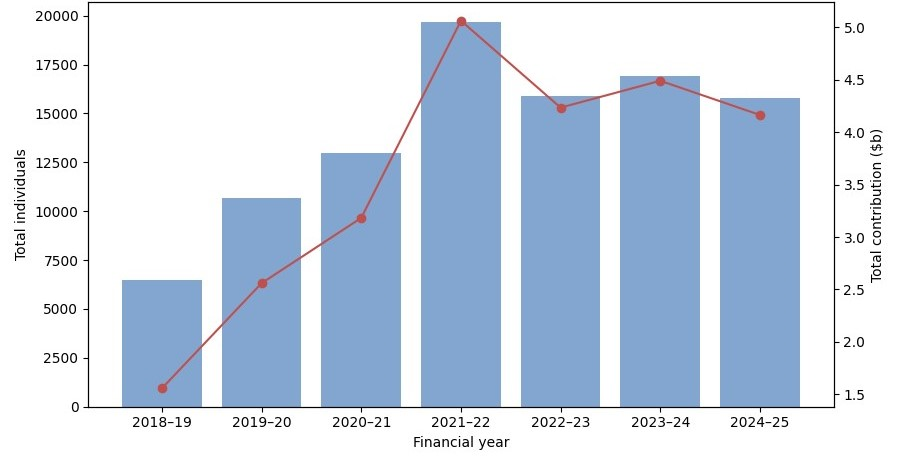
Source: Australian Tax Office


Which leads to the inevitable question: has interest in home downsizing faded?

Not really. The initial rise in downsizer contributions was powered by people who were already planning to sell. For financially literate retirees with strong super balances and little reliance on the Age Pension, the policy was an obvious opportunity and many moved quickly to take advantage of it.

But a downsizer contribution can only be used once in a lifetime. When those early adopters acted, they permanently exited the pool of potential contributors. By 2021–22, many of the most prepared and motivated households had already made their move.

What followed was a predictable plateau, not a sudden loss of interest.


Many older Australians aren’t selling

Downsizer contributions depend entirely on one thing: older people selling homes. And despite high property prices, many are not willing to make the move.

This was one of the key findings in Vanguard’s How Australian Retires 2025 report, which found that less than 30% of retired Australians have moved or are planning to move into a new home since retiring.

In fact, most retirees see their home as something to hold onto either for life or to pass on as an inheritance. Only 9% of those surveyed considered their home a potential source of retirement funding.

For many older Australians, the family home represents stability, security and independence — benefits that rising prices alone don’t sever.


Interest‑rate uncertainty has bred caution

The past few years have also been marked by sharp swings in interest rates and economic uncertainty. While retirees may carry little debt, they are often more sensitive to volatility than younger households.

Selling into a shifting market raises fears of poor timing, unexpected price falls or difficulty securing suitable replacement housing. In that environment, many retirees have adopted a “wait and see” approach — delaying major decisions, including downsizing.


A lack of supply

Another persistent issue is supply. For downsizing to make sense, retirees need access to smaller, well‑located, accessible homes — ideally within their existing communities.

In many areas, that stock is limited. New apartments may be expensive, poorly designed for ageing residents or poorly located relative to services and family. When suitable housing is scarce, downsizing stalls — and so do downsizer contributions.


The Age Pension remains a silent spoiler

Perhaps the biggest structural brake on downsizer contributions is the government Age Pension.

The family home is exempt from the pension assets test. Superannuation is not. When retirees sell their home and move funds into super via a downsizer contribution, they can inadvertently reduce or eliminate their pension entitlement.

This trade‑off is well understood by financial advisers and deeply felt by retirees near pension thresholds. For many, protecting or maximising the Age Pension outweighs the tax advantages of holding more assets inside super.


A mature scheme meets structural limits

The decline in downsizer contributions largely reflects the reality that downsizing is complex, deeply personal and shaped by pension rules, housing supply and risk aversion.

Early demand has largely been met. What remains is a smaller, steadier flow of people who are ready to move when circumstances align. For most retirees, the decision will continue to hinge on lifestyle, certainty and suitability — not just numbers on personal finances.

For more information on home downsizer contributions including eligibility, contribution limits, and how to make a contribution, visit the ATO website.


Vanguard
11 February 2026
vanguard.com.au

Hot Issues

Bedford Finance Logo

General Advice Warning
All strategies and information provided on this website are general advice only which does not take into consideration any of your personal circumstances.
Please arrange an appointment to seek personal financial, legal, credit and/or taxation advice prior to acting on this information.
Credit Representative: 383917 is authorised under Australian Credit Licence 391209.
Disclaimer Privacy Policy

Staff Name

Sed consectetur placerat viverra. Praesent sollicitudin erat quis maximus iaculis. Nam quis augue dolor. Morbi sapien urna, consectetur vel scelerisque et, efficitur vitae augue. Nullam elementum erat pulvinar scelerisque maximus. Cras placerat tincidunt semper. Vestibulum mollis enim finibus augue aliquam condimentum. Phasellus molestie lorem quis leo porta pretium. Fusce lacinia lorem elit, et finibus lectus efficitur a.

Quisque tellus odio, convallis luctus imperdiet vitae, tristique eget nulla. Ut nibh enim, tincidunt eu molestie vel, sodales at mauris. Praesent fermentum nibh felis, dapibus faucibus neque vulputate vitae. Sed feugiat orci vitae purus suscipit, malesuada commodo arcu semper. Integer condimentum venenatis ligula iaculis rutrum. Vestibulum tempor orci non posuere molestie. Integer mi ipsum, feugiat at metus sit amet, tempus finibus sem.

General Disclaimer

All care is taken in the preparation of the information and published on this website. Bedford Finance does not make any representations or give any warranties about its accuracy, reliability, completeness or suitability for any particular purpose.

To the extent permissible by law, Bedford Finance will not be liable for any expenses, losses, damages (including indirect or consequential damages) or costs which might be incurred as a result of the information being inaccurate or incomplete in any way and for any reason.

If you have any concerns regarding the content of the website, please contact us.

Privacy Policy

Bedford Finance is committed to providing quality services to you and this policy outlines our ongoing obligations to you in respect of how we manage your Personal Information.

We have adopted the Australian Privacy Principles (APPs) contained in the Privacy Act 1988 (Cth) (the Privacy Act). The NPPs govern the way in which we collect, use, disclose, store, secure and dispose of your Personal Information.

A copy of the Australian Privacy Principles may be obtained from the website of The Office of the Australian Information Commissioner at https://www.oaic.gov.au/.

What is Personal Information and why do we collect it?

Personal Information is information or an opinion that identifies an individual. Examples of Personal Information we collect includes names, addresses, email addresses, phone and facsimile numbers.

This Personal Information is obtained in many ways including correspondence, by telephone and facsimile, by email, via our website www.bedfordfinance.com.au, from your website, from media and publications, from other publicly available sources, from cookies and from third parties. We don't guarantee website links or policy of authorised third parties.

We collect your Personal Information for the primary purpose of providing our services to you, providing information to our clients and marketing. We may also use your Personal Information for secondary purposes closely related to the primary purpose, in circumstances where you would reasonably expect such use or disclosure. You may unsubscribe from our mailing/marketing lists at any time by contacting us in writing.

When we collect Personal Information we will, where appropriate and where possible, explain to you why we are collecting the information and how we plan to use it.

Sensitive Information

Sensitive information is defined in the Privacy Act to include information or opinion about such things as an individual's racial or ethnic origin, political opinions, membership of a political association, religious or philosophical beliefs, membership of a trade union or other professional body, criminal record or health information.

Sensitive information will be used by us only:

Third Parties

Where reasonable and practicable to do so, we will collect your Personal Information only from you. However, in some circumstances we may be provided with information by third parties. In such a case we will take reasonable steps to ensure that you are made aware of the information provided to us by the third party.

Disclosure of Personal Information

Your Personal Information may be disclosed in a number of circumstances including the following:

Security of Personal Information

Your Personal Information is stored in a manner that reasonably protects it from misuse and loss and from unauthorized access, modification or disclosure.

When your Personal Information is no longer needed for the purpose for which it was obtained, we will take reasonable steps to destroy or permanently de-identify your Personal Information. However, most of the Personal Information is or will be stored in client files which will be kept by us for a minimum of 7 years.

Access to your Personal Information

You may access the Personal Information we hold about you and to update and/or correct it, subject to certain exceptions. If you wish to access your Personal Information, please contact us in writing.

Bedford Finance will not charge any fee for your access request, but may charge an administrative fee for providing a copy of your Personal Information.

In order to protect your Personal Information we may require identification from you before releasing the requested information.

Maintaining the Quality of your Personal Information

It is an important to us that your Personal Information is up to date. We will take reasonable steps to make sure that your Personal Information is accurate, complete and up-to-date. If you find that the information we have is not up to date or is inaccurate, please advise us as soon as practicable so we can update our records and ensure we can continue to provide quality services to you.

Policy Updates

This Policy may change from time to time and is available on our website.

Privacy Policy Complaints and Enquiries

If you have any queries or complaints about our Privacy Policy please contact us at:

0421 63 23 90